|
HOME
> PRODUCTS
> UK
BRANCH > 2005 SWANAGE RAILWAY TRIP REPORT
HOME
| PRESS
RELEASES | USA
PRODUCTS | UK
PRODUCTS | ONLINE
STORE
GO
BACK TO THE SWANAGE ROUTE PAGE
The
3DTS-UK 2005 Swanage Railway Trip Report
| In
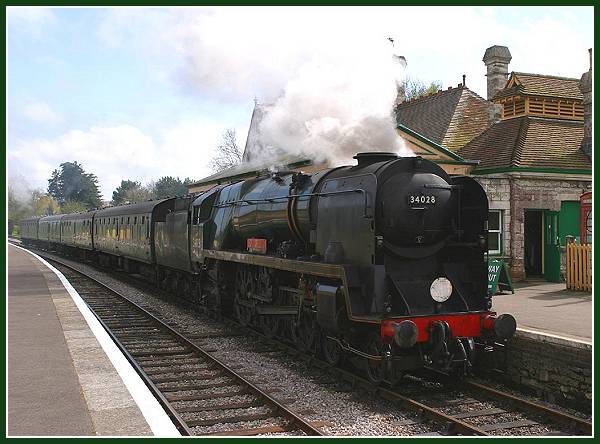
April 2005 the Swanage Railway invited some of the
3DTrainStuff-UK guys, Richard Scott, Martin Heywood,
and Nigel Apperley, to come out and have a go at
firing their famous Eddystone steam locomotive.
The following are some photos they took, and some
excerpts from their trip report. |
 |
Martin
Heywood's report..
For
me, the best part of the experience was probably
firing on the way up to Norden. I was kept busy
most of the time and the fireman was very informative.
I finally understand why they are able to drive
a Bulleid at 25mph without it blowing off all
the time - the grate is almost empty. Indeed,
the fireman told me not to put much coal near
the front of the firebox as the boiler would be
impossible to control. Of course, in MSTS you
drive with the grate full of coal, which explains
why the boiler makes far more steam than the loco
needs and the injectors don't have the desired
effect. FYI, we kept around 200psi most of the
way with a boiler rated to 250psi.
Nigel
definitely had the better drive in that he was
going forwards and up hill for much of the way.
Driving in reverse was awkward and you don't see
much with such a big tender in front of you. I
have to say that I was quite underwhelmed by the
driving part, mainly I think because I never really
felt in control.
<-
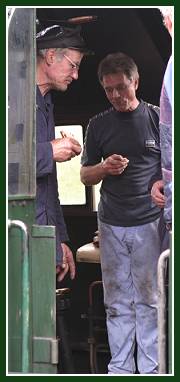
Ron (at far left) talking to Richard Scott.
|
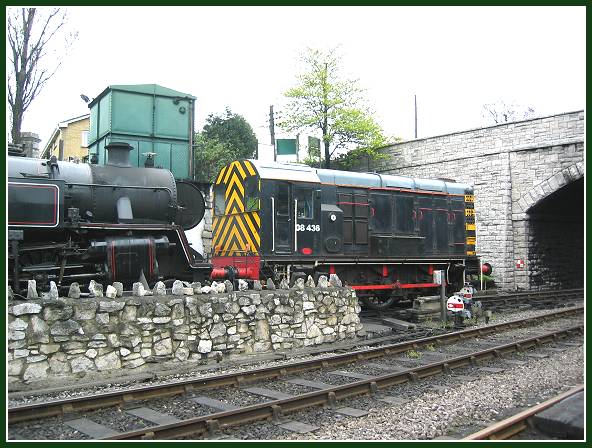
Near
the SR Engine house
|
Martin
Heywood's report cont..
For
one thing, you have someone telling you what to
do, so you are really just an extension of his
arms, but also the loco is such a dinosaur that
you don't really feel much response to your actions
(except perhaps when braking). For example, when
setting off, you open up the regulator and nothing
happens at first. Then, the steam chest needle
rises and slowly you set off. Almost immediately,
you set the cut-off at around 30% and that's it,
the loco drives itself.
Of
course, apart from the climb out of Corfe, you
don't use the regulator much on the return trip,
so most of my time was spent working the brake.
I suppose I was more in control here, because
the driver simply said slow down and left the
rest to me. Having said that, the loco still seemed
to know just what to do without me needing to
try too hard. For example, approaching the home
signal at Harman's Cross, I braked slightly to
slow down, but because we're on a rising gradient
here, we still slowed gently after I released
the brake and stopped right in front of the signal.
It was far easier than in the sim! Approaching
Swanage I set the vacuum to 15 inches and we slowed
down nicely. I wasn't quite happy with the deceleration,
so I knocked the vacuum down by another couple
of inches and again the loco seemed to know just
what to do. I definitely need to take another
look at the brakes on our locos, because the real
thing was far more responsive than the sim, especially
when I braked too hard stopping in Swanage station
- I hope the guard wasn't drinking his tea at
the time :-)
|
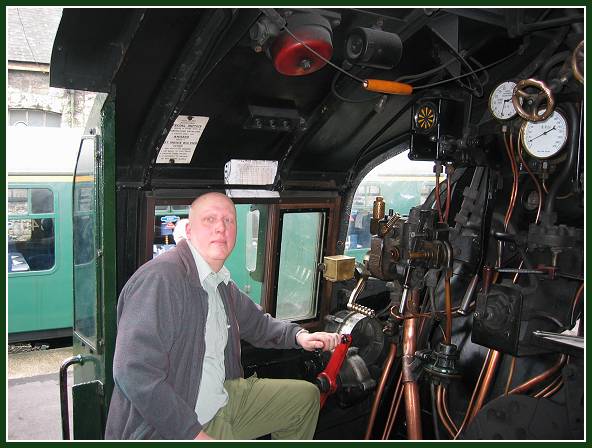
Nigel
Apperley at the controls on the Eddystone
|
Nigel
Apperley's report..
As
Martin said, Ron was pretty much telling us exactly
what to do during the driving part so we didn't
have much chance to think for ourselves. When
we set off I opened the cut-off to about 70 and
then eased open the regulator, about half way
at first and then full on, the lever was easy
to move and cooler than I expected. The steam
took a few seconds to get to the cylinder and
then the cylinder pressure climbed quickly and
the loco started to move off so I eased the reg
back down to half way again. When we were passing
the shed I opened the regulator right up and wound
the cut-off back to 30, from then on most of the
driving was done with the regulator wide open
and making small adjustments on the reverser.
I found that the reverser had to be locked off
because if you didn't it crept round towards 75.
The view from the driver's side was not too bad
and you could get some view on a right hand bend
by leaning right out of the window, but not much.
The
train picked up speed on the climb to Harman's
cross and was hunting quite a bit from side to
side, I asked the fireman about this later on
and he said that he thought we got up to about
35. The heat was quite fierce on the side of my
leg as there are no metal shields on this footplate,
I ended up putting my right arm across my body
for some of the time to cool it off. When we were
passing the crossing before Harman's cross, Ron
asked me to shut off and I inexplicably reached
for the reverser, Ron then shouted "No the regulator",
so I grabbed the handle quickly, I must confess
that this wasn't the last time I did this and
to my shame he actually shut off the steam himself
on the last occasion. Why I got confused over
this is a mystery, If you can take off and land
a plane without any trouble then a steam train
shouldn't be a problem. I suspect that not being
allowed to think for yourself had something to
do with it.
|
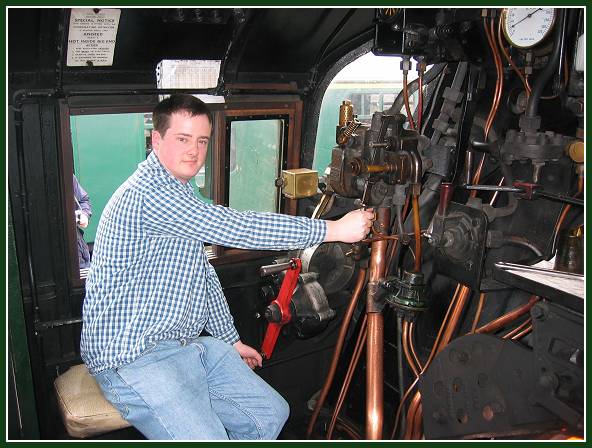
Martin
Heywood takes his turn at the controls.
|
Nigel
Apperley's report cont..
Coming
in to Harman's cross, the train ran more freely
than I had expected without any power. I started
braking somewhere past the distant signal and
found the brake very responsive and easier to
use than the one in the sim. I took the brake
pressure carefully down to about 15 at first and
then down to about 7, I eased off and kept it
at12 until we reached the home signal, then I
took the brake off. It took a surprising amount
of time for the brakes to come fully off, I would
estimate about 20-30 seconds, and the train coasted
through the points at (I would guess) about 7-10
mph. I then braked it to a halt by the signal
box while we waited for the DMU to come through
the other loop.
I
think I managed to whistle at every board (any
excuse). We accelerated quite quickly out of Harman's
cross and kept the power on down the bank with
a much reduced cut-off (about 20) until we hit
the next short climb which took some of the speed
off, we then coasted down the gradient to Corfe
Castle, again the braking started just past the
distant signal and we entered the points doing
less than 10 mph and coasted right through the
station without stopping. I opened the regulator
right up again with a cut-off of about 30 and
this took us through the cutting and onto the
viaduct. Because the ground is pretty level up
to Norden I was able to cut the steam off and
coast in at about 15, I braked just before the
bridge and came to a halt at the platform. Ron
then positively jumped onto the controls (which
was a shame) and took the engine around the train.
I would say that I enjoyed driving very much as
an experience, but that I would have proffered
to have someone explain what to do beforehand
rather than telling me what movements to make
at the time.
After a swift cup of tea (while the fireman hosed
the footplate) we headed back towards Swanage.
The fireman was a very friendly man who drives
EMUs for a living and fires steam trains for fun,
he was pretty informative and told us a lot about
the strategy he was using. I started off by shovelling
coal into the two back corners of the firebox
on either side of the firehole. The coal was in
pretty large lumps and at first I found it hard
to get more than two lumps on the shovel at once,
in fact I dropped about three lumps onto the footplate.
I used the technique of banging the shovel on
the rim of the firehole so that the coal goes
right into the corner (See "firing days" by H
Gasson), whilst being conscious of Martin's warning
about burning your hands due to the radiant heat.
I then dropped some coal onto the very back of
the fire underneath the firehole. A small hole
was visible linear the back of the firebed so
I filled that and then started working on the
back again. At this stage we were moving off and
it was becoming hard to get coal under the rim
because the draught pulled it off the shovel,
I worked out that flipping the shovel over at
an angle seemed to hit the spot. This was enough
coal for the first part of the journey, about
four on each side at the back and four under the
firehole, with a thin even bed maintained across
the grate. It wasn't necessary to drag any coal
down from the tender as the movement of the train
kept it rolling down within easy reach.
The strategy was to use the small heap of coal
at the back of the grate to keep a minimal fire
going, whilst using the injectors to keep the
boiler full and keeping the firebox doors open
most of the time to cool the fire. The effect
of this was to keep a steam pressure of between
200 and 225 whilst minimising the amount of black
smoke from the chimney.
With the power on, the draught through the fire
increased and it became very bright and hard to
look at, the radiant heat increased to the point
where it was uncomfortable to stand directly behind
the firehole even at the very back of the cab,
it was usually better to stand right over to one
side. It was difficult to keep a good watch because
of the coal dust blowing off the tender which
kept getting in my eyes.
As the engine was going downhill most of the time,
the water glasses showed near the top for the
whole journey. I noticed that the water was cloudy
red at first (treatment) becoming clear later
on. I turned the injectors on twice during the
journey, there are two sets of live injectors
on the loco, with handwheels near the footplate
under the right hand windows. The technique was
to open the water valve first, then open the steam
injector valve fully (about 6 turns of the wheel),
at which point the injector comes on with a roaring
noise. The injector stayed on for about 3-5 minutes,
after this I turned the steam valve off before
slowly and carefully closing the water valve.
The fireman said that he would normally alternate
between the two injectors, but on such a short
trip it wasn't really necessary.
I put more coal in shortly after Harman's cross,
so that the fire would be clean by the time we
got to Swanage,. All in all a very enjoyable trip
and over too quickly, as I said to the fireman,
if only we were able to take that locomotive on
a good run down the main line. As Martin said,
the firing was actually more interesting than
the driving and it is a pity that it wasn't better
implemented in the simulator. I think that you
could enjoyably spend your time just firing while
some sort of autopilot drove the engine.
|
|
Martin
Heywood weighs in with one more comment..
One
of the things that the sim handles very badly
is the effect of the draught on the fire. When
I started shovelling coal at Swanage, the fire
was an orange colour like a coal fire in a household
grate, but within seconds of leaving it was bright
yellow and incredibly hot. You can start the fire
off cold in the sim, but once it burns up, it
doesn't cool down again - it stays at 1000 degrees
unless you put lots of coal on. I was tempted
to adjust some of the settings in the eng file
to make the fire smaller and cooler, but the problem
is that with the automatic fireman on, the fire
would soon build up to the "ideal" size and temperature.
Re
the vacuum brake, I think one of the reasons why
it took so long for the brake to release was that
the handle stuck part way between lap and full
release. I almost stopped prematurely coming into
Swanage with the brake not fully released. I asked
Ron why I was only getting 18-19 inches of vacuum
and he gave the brake handle a good shove and
magically we had 21 inches. I reckon I must have
had the brake in this position most of the way
from Harman's Cross to Swanage, which would explain
why the train didn't run away down the hill.
The one thing that Nigel didn't mention was the
engine brake. I used this a few times even though
we had 4 vacuum braked carriages on. This brake
works directly by pulling a lever, so is easier
to control than the train brake (and quicker to
release of course). The only problem with it is
that it springs off when you let go, so Ron stuck
a spanner behind it to jam it open. This same
spanner was also used on the way up when one of
the water valves stuck open. The fireman couldn't
release it and it took Ron's experience to fix
the problem. I asked him whether he had to use
the spanner often on this valve. "No", he replied.
"A good kick normally cures it".
|
GO
BACK TO THE SWANAGE ROUTE PAGE

3D
Train Stuff.. its more than just trains!
|



